Character Info
04669
繁
繁
阜 170.9
⿰阝⿳口𧘇
撇
12
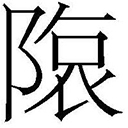 GHZR74461.15 |
IRGN2269PostponedV5.0
glyph no change, irg49. pending for additional information (The description says it is 俗字, but of which character?), irg48.
glyph no change, irg49. pending for additional information (The description says it is 俗字, but of which character?), irg48.


Comments
IRGN2179 Henry Review - Part 2.txt
04669 GHZR74461.15 normalize right hand side to 哀 Raw Info
| 0 - Sequence Number | 04669 |
| 1 - Disscussion Record | glyph no change, irg49. pending for additional information (The description says it is 俗字, but of which character?), irg48. |
| 2 - UTC Source | |
| 3 - UTC Image | |
| 4 - UK Source | |
| 5 - T Source | |
| 6 - T Image | |
| 7 - K Source | |
| 8 - K Image | |
| 9 - SAT Source | |
| 10 - SAT Image | |
| 11 - G Source | GHZR74461.15 |
| 12 - G Image | GHZ74461.15.bmp |
| 13 - UTC Code | |
| 14 - Kangxi Radical | 170 |
| 15 - Stroke Count | 9 |
| 16 - First Stroke | 3 |
| 17 - T/S (0/1) Flag | 0 |
| 18 - IDS | ⿰阝⿳口𧘇 |
| 19 - Radical Stroke (RS) | 3 |
| 20 - RS+SC(stroke count) | =P61+T61 |
| 21 - Total Stroke | 12 |
| 22 - 修正总笔画数 | |
| 23 - Similar Ideographs | |
| 24 - UTC Evidence (Figure No.) | |
| 25 - UTC Evidence (Title) | |
| 26 - UTC Evidence (Location) | |
| 27 - UTC kTotalStrokes | |
| 28 - UTC Ext. F2 Serial No. | |
| 29 - T References to evidence documents A | |
| 30 - T References to evidence documents B | |
| 31 - T File name of evidence image | |
| 32 - T kTotal Strokes | |
| 33 - K Ref. to Evidence doc | |
| 34 - K file name of evidence image | |
| 35 - K kTotalStrokes | |
| 36 - G Ref. to Evidence doc | 《汉语大字典》(第二版) |
| 37 - G Page No. in Evidence file(optional) | 4461 |
| 38 - G Row No. in Evidence file(optional) | 15 |
| 39 - G Position in the Row (optional) | 1 |
| 40 - G file name of evidence image | GHZ74461.15.jpg |
| 41 - G kTotalStrokes | 12 |
| 42 - SAT Evidence | |
| 43 - SAT kTotalStrokes | |
| 44 - UK Ref. to Evidence doc | |
| 45 - UK file name of evidence image | |
| 46 - UK Font code point | |
| 47 - UK Font glyph | |
| 48 - UK Other source references | |
| 49 - UK Mapping to traditional or simplified character | |
| 50 - UK Total stroke count | |
| 51 - UK Note |
Comments
COMMENT
在《龍龕手鏡(龍龕手鑑)》中,並非所有的俗字都有正體,有些俗字是用於民俗文獻中的新造字(本無正體),而《龍龕手鏡(龍龕手鑑)》將這種字也視爲「俗體」(參鄭賢章《龍龕手鏡研究》第98和第99葉,見附圖1、2)。就GHZR74461.15而言,我們僅僅知道這是一个从阜、哀聲的形聲字,由於缺乏對應的語料,我們無法肯定這个字是否真的有正體存在。
Translation by Henry:
In Longkan, not all vulgar characters have corresponding orthodox characters. Some vulgar characters are new characters used in 民俗 literature (which means no orthodox variant exists), and Longkan regards these characters as vulgar characters too. Per GHZR74461.15, we can only know that it is a phono-semantic character with 阜 semantic and 哀 phonetic. Due to lack of other materials, we cannot be sure if there is any corresponding orthodox variant.
Source Materials quoted by Chau:
Translation of characters in red: Some vulgar characters are newly created variants, there is no corresponding orthodox character.
(the term vulgar) is relative to orthodox or newly created characters which (by definition) do not have any orthodox form.
Rough translation: Longkan vulgar characters contain a decent amount of newly created phonetic transliteration characters which do not have orthodox forms. Compared to other dictionaries, not only does Longkan include them, but also treats them as vulgar characters... We think that Longkan's classification is reasonable... these phonetic transliteration characters only exist in specific 民俗 literature, and does not appear in "proper" (正統) literature, so they fit the nature of vulgar characters.
--
Suggestion: Move character back to M-set.
NORMALIZATION