Character Info


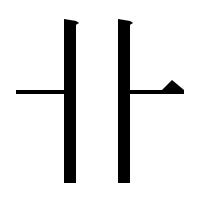


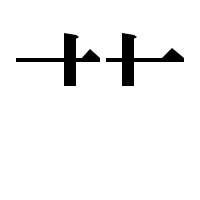


Attributes:
Meeting Minutes
| Date | Description |
|---|---|
| IRG #63 2024-10-23 (Wed) 11:48 am +0900 Recorded by CHEN Zhuang | no change. |
Attribute Changes
| Version | Description |
|---|---|
| 2.0 | For 00002, add Discussion Record "No change, IRG 63." |
Glyph Changes
| Source Reference | Glyph |
|---|---|
| UTC-03396 |  1.0 1.0 |
Raw Info
| Character Reference | UTC-03396 |
| Codepoint | F543 |
| Radical | 1 |
| Stroke Count | 2 |
| First Stroke | 3 |
| Total Stroke | 2 |
| IDS | ⿻十丿 |
| Variants | U+5344, U+535D, U+5EFE, U+6563, U+8279, U+21B1D |
| Pronunciation | N/A |
| Total No. of Evidences | 27 |
| Notes | kSemanticVariant U+6563, kSpoofingVariant U+5344 U+535D U+5EFE U+8279 U+21B1D |
Review Comments
Eiso Chan, Request to discuss how to handle the Sanban Sign for Chinese folk music and local operas, IRG N2540
IRG Meeting #59 Recommendations and Action Items, Recommendation IRG M59.7: IRG has no objection to encode Sanban signs as a complete set of musical symbols under a symbol notation system, separate from CJK characters.
Eiso Chan, Updated proposal to encode the Sanban Sign for Chinese folk music and local operas, L2/22-207R
Recommendations to UTC #174 January 2023 on Script Proposals, ... Such usage would reflect likely past practice, which would have found appropriate glyphs in
existing CJK fonts for such usage in scoring.
Eiso Chan, Proposal to add one common character to mark the rhythm of Chinese traditional music to UAX #45, L2/23-214
CJK & Unihan Group Recommendations for UTC #177 Meeting, ... The ideograph, whose representative glyph is shown below, can therefore be considered as a candidate for inclusion in the UTC’s submission for the next IRG working set.
kSpoofingVariant U+535D 卝
kSpoofingVariant U+5EFE 廾
kSpoofingVariant U+8279 艹
kSpoofingVariant U+21B1D 𡬝
Per Henry’s feedback on IRGN2540, it would be advisable for Eiso to consider including an additional character for the non-abbreviated form 散 in the proposal document to WG2.
The proposed character with the bar(一) in the middle but the variant of 廿 have a bar on the top. So they are non-cognate indeed.