Character Info
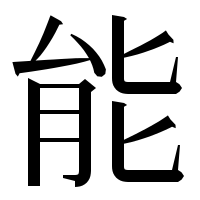
03144
 GZHSJ-0029 |
No change, new evidence for reference for China, IRG 66.
New evidences accepted, IRG 65.
Not unified to 䏻 U+43FB, radical no change, IRG 63.
New evidences accepted, IRG 65.
Not unified to 䏻 U+43FB, radical no change, IRG 63.
Similar To: Semantic Variant能 (U+80FD)



Attributes:
Meeting Minutes
| Date | Description |
|---|---|
| IRG #66 2026-03-17 (Tue) 11:18 am +0800 Recorded by CHEN Zhuang | no change, new Evidence for reference to China. |
| IRG #65 2025-10-15 (Wed) 9:42 am +0800 Recorded by CHEN Zhuang | new evidences accepted. |
| IRG #63 2024-10-22 (Tue) 10:03 am +0900 Recorded by CHEN Zhuang | Not unified to 䏻 U+43FB, Radical kept as 130.0 肉 |
Attribute Changes
| Version | Description |
|---|---|
| 2.0 | For 03144, add Discussion Record "Not unified to 䏻 U+43FB, radical no change, IRG 63." |
| 4.0 | For 03144, add Discussion Record "New evidences accepted, IRG 65." |
| 5.0 | For 03144, add Discussion Record "No change, new evidence for reference for China, IRG 66." |
Glyph Changes
| Source Reference | Glyph |
|---|---|
| GZHSJ-0029 | 1.0 |
Raw Info
| Character Reference | GZHSJ-0029 |
| Codepoint | E234 |
| Radical | 130.6 |
| Stroke Count | 6 |
| First Stroke | 5 |
| Total Stroke | 10 |
| IDS | ⿰䏍长 |
| Variants | Semantic Variant能 |
| Pronunciation | neng2 |
| Total No. of Evidences | 3 |
| Notes | N/A |
| Secondary Radical | N/A |
| Secondary Stroke Count | N/A |
| Secondary First Stroke | N/A |
Review Comments
The evidence above suggest this is a unifiable variant of 䏻 (U+43FB), which is in turn a variant of 能
⿰䏍長 in 异体字字典
Is it suitable to treat this one as the bottom component of U+2E292 𮊒?
For Comment #11685, this variant is very common in Japan and China. The three photos below were taken in Japan:
The variants shown below are reflected in both the evidence in this IRG working set and in the information I have collected:
Zi.tool:
浙江同济科技职业学院标语:
《圕標準簡字字表》, 中國圕服務社, 民國23年1月, p. 5:
歐陽溱:《簡體字考證》, 1936年6月, p. 15:
See below for other variants of 长
《論俗字下》1934年3月16日, 《論語》半月刊第37期, p. 657:
鍾紀: 《字庫》, 建新出版社, 1952年10月第五版, p. 426-427:
《第一批簡體字表》, p. 15-16:
If these variants can be unified and added as a new UCV, then ⿰䏍长 could be used in 𮊒.
(JMJ-003817, Unicode v16.0).
▲ 顧一樵 (顧毓琇), 梁實秋, 應尚能: 《荆軻插曲》, 重慶: 詠葵樂譜刊印社, 1940.1, flyleaf
▲ 《杜山威等造像銘》, 唐·武周·天授二年
Support Comment #2717.
If Japan wants to move JMJ-003817 to the new code point, that will be acceptable in future.
Note that unifications found in the IVD are not binding, but can be considered, along with other evidence.